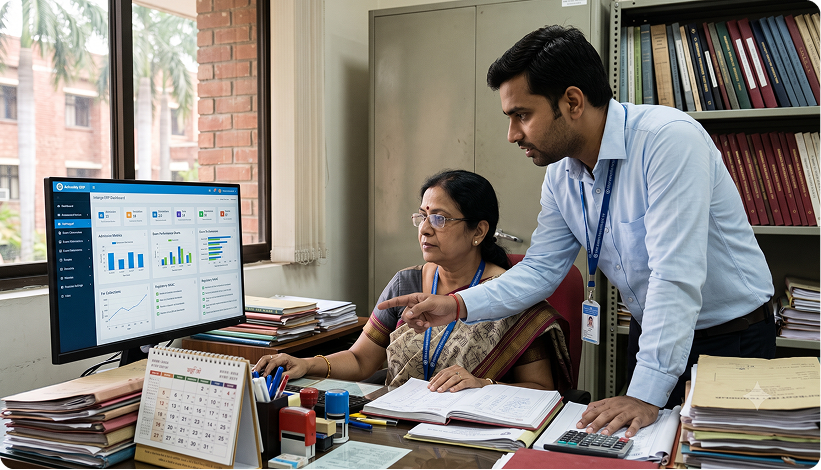
Universities cannot afford fragmented academic and administrative systems that delay decisions, compromise data consistency, and increase reporting workloads. When admissions, examinations, fee collection, faculty records, and accreditation data operate in silos, administrative complexity grows, making institutional performance harder to monitor and resources more difficult to manage.
An integrated ERP for university management connects these functions, streamlines workflows, and provides leadership with reliable institutional data. For universities in India, the right platform must also accommodate local higher education requirements and evolving academic structures. This guide explores what institutions should evaluate when selecting the best ERP and how Edumate fits into that decision.
What Makes an ERP the Best for Universities in India?
The best ERP for universities aligns with the institution’s academic structure, administrative processes, regulatory obligations, and long-term growth plans. Five capabilities should guide the selection process.
Complete Student Lifecycle Coverage Prevents Operational Silos
A student’s journey spans admissions, enrolment, academics, examinations, fee payments, mentorship, and placements. When these functions operate independently, duplicate data entry, inconsistent records, and repeated follow-ups increase administrative workloads.
A comprehensive university management software platform should connect these activities through a consistent student record, enabling departments to access relevant information without repeatedly requesting it from other teams. Key capabilities include:
- Admissions and enrolment: Application processing, document management, eligibility checks, and registration.
- Academic and examination management: Programme structures, course allocation, hall tickets, evaluation, and results.
- Finance and student services: Fee collection, scholarships, mentorship, grievance handling, and placement coordination.
Connected workflows reduce duplication and improve visibility across the student lifecycle, from application to graduation.
Indian Regulatory and Accreditation Requirements Must Shape the ERP
Indian universities must manage academic frameworks and reporting obligations across multiple departments. An ERP should support structured data collection for applicable requirements, including:
- NAAC: Institutional data organisation and evidence preparation.
- NBA: Programme-level academic records and Outcome-Based Education (OBE), including Course Outcome (CO) and Program Outcome (PO) mapping.
- NIRF: Collection and consolidation of data required for applicable ranking parameters.
- NEP 2020 and AICTE: Academic structures, credit-related workflows, and relevant requirements within the institution’s regulatory scope.
An ERP can improve reporting readiness but cannot guarantee compliance or accreditation. Verify the specific reports and evidence-management capabilities available.
Cloud-Based Access Improves Institutional Coordination
A cloud-based college management information system for universities provides authorised users with access to centralised information across departments and campuses. Depending on the deployment model, it can also simplify updates and reduce reliance on locally maintained servers.
Evaluate multi-campus support, integrations, scalability, backup, recovery, service availability, and access permissions before selecting a platform.
Data Security Must Be Evaluated at the System Level
Student records, examination data, financial transactions, and employee information require appropriate protection. Security should therefore be a core procurement criterion, not an afterthought.
Evaluate the platform’s role-based access controls, authentication, audit trails, backup arrangements, and incident-response processes. Security certifications should be verified for their validity, scope, and applicability to the proposed service. Universities should also clarify contractual provisions for data ownership, retention, hosting, and recovery.
Management Dashboards Turn Institutional Data into Action
University leaders need timely insights into admissions, enrolment, fee collection, academic performance, examination results, and placements to make informed decisions.
Dashboards should enable department-level analysis, while AI-driven analytics, where available, can help identify patterns and inform resource planning. Reliable data and appropriate governance remain essential.

Why Edumate Is the Best ERP for Universities
Developed by iTech for higher education, Edumate connects admissions, academic tracking, examinations, faculty information, placements and reporting on one platform. What matters is how well that fits your operating model, not how many modules appear on paper.
One Platform Connects Departments Around Shared Data
When every department runs its own application, the information exists, but assembling a consistent institutional picture takes time. Edumate brings key higher education functions into one environment, which reduces the effort of moving information between teams and improves visibility across student and academic processes.
Admissions data can feed enrolment reporting. Academic records can inform performance analysis. Examination data can flow into institutional reports. The result is better coordination and a stronger base for monitoring the whole institution. Confirm the exact integrations and automated workflows in a demo.
Built for India’s Higher Education Workflows
A university management system in India must accommodate varied academic structures, examination practices, and reporting requirements. Edumate covers admissions, CO-PO mapping, faculty performance, examinations, placements, and reporting.
For engineering and technical institutions, CO-PO mapping connects course outcomes with programme outcomes and supports academic evidence collection. Verify compatibility with your grading structures, credit systems, and academic regulations before implementation.
Customisable for Autonomous, Affiliated and Multi-Campus Universities
Autonomous, affiliated, and multi-campus institutions differ in examination responsibilities, approval hierarchies, and academic structures. An ERP should accommodate these variations without requiring separate systems for each department or campus.
Edumate offers configuration options for:
- Institution-specific approval workflows
- Different programmes, departments, and course structures
- Variations in examination and evaluation
- Centralised reporting with campus-level responsibilities
- Future modules and integrations
Confirming these requirements early can reduce costly reconfiguration as the institution expands.
AI-Driven Analytics for Academic and Resource Planning
Where supported, AI-driven analytics can help institutions identify student performance patterns, monitor operational indicators, and assess resource utilisation across programmes.
Insight is only as good as the data behind it, and analytics should support professional judgement, not replace it, especially when decisions affect individual students.
Edumate’s AI and analytics capabilities can be understood through:
- AI and analytics features currently available
- Data used to generate insights
- Safeguards governing data access and use
Security Standards and Certifications
Security and privacy are important considerations when managing institutional data through a college ERP system. Certifications such as SOC 2 Type II, ISO 27001, and ISO 27701 demonstrate adherence to defined standards and controls within their respective scopes.
Edumate prioritizes secure institutional data management through practices aligned with applicable security and privacy requirements, supporting institutions in managing sensitive academic and administrative information with confidence.
Edumate Modules for University Management
Edumate brings together key academic and administrative functions. Evaluate the following modules against your institution’s operational requirements.
Enrollment and Admissions Management
An integrated admissions module can streamline application processing and improve visibility into programme demand. Evaluate support for:
- Online applications and document management
- Applicant records and admission tracking
- Programme-level enrolment
- Year-over-year comparisons, where historical data exists
These insights can inform recruitment and resource planning.
Programs, Courses and CO-PO Mapping
Universities need to connect programmes, curricula, courses, teaching responsibilities, and academic outcomes. CO-PO mapping links course outcomes with programme outcomes, supporting academic review and accreditation evidence when appropriate attainment data is available. Verify that departments can manage and analyse these records without maintaining parallel datasets.
Examination Management
Examination management spans scheduling, eligibility, evaluation, and result publication. Evaluate whether the module supports:
- Scheduling and eligibility checks
- Hall-ticket generation
- Evaluation and marks entry
- Result analysis and reporting
- Access controls for examination data
Confirm the available automation against your institution’s examination regulations.
Fee and Scholarship Management
Fee management requires accurate student records and visibility into payments, dues, scholarships, and concessions. An integrated system can connect fee records with student information and simplify collection reporting.
Verify support for instalments, refunds, scholarship approvals, payment gateways, and accounting integrations.
Faculty, Mentorship and Grievance Management
Faculty administration extends to teaching responsibilities, performance records, and mentorship assignments. Connected mentorship and grievance workflows help authorised staff track responsibilities and the status of student concerns. Defined escalation procedures and access controls remain essential.
Placement Management
Placement teams coordinate student information, training, employer engagement, eligibility and recruitment outcomes. When those records are fragmented, participation patterns are hard to see and consolidated reports take effort. Ask how the platform handles:
- Student profiles and training records
- Employer information
- Recruitment stages
- Placement reporting
Accreditation and Institutional Reporting
Accreditation and ranking reports require data from multiple departments and reporting periods. Maintaining structured records throughout the year can reduce last-minute data collection and inconsistencies.
For NAAC, NBA, and NIRF, verify the supported templates, data fields, calculations, and evidence workflows. Institutional validation and supplementary documentation may still be required.

Best ERP for Universities: Selection Checklist
Selecting an ERP is a long-term operational decision. A structured evaluation helps universities distinguish between a platform that simply digitises existing activities and one that can support institutional growth.
Use the following checklist during vendor discussions and product demonstrations.
Admissions and Enrollment Management
Verify whether the system supports the institution’s application, document, eligibility, enrolment, and historical reporting requirements. Ask how it handles multiple programmes and admission cycles.
Programs, Courses, and Outcome-Based Education
Check whether academic structures can be configured to match institutional regulations. For relevant programmes, examine CO-PO mapping, attainment records, and the reporting capabilities available.
Examination and Result Management
Ask the vendor to demonstrate the complete examination workflow, from scheduling and eligibility through evaluation and result analysis. Confirm how sensitive records and changes are controlled.
Fee and Scholarship Management
Evaluate fee structures, payment records, scholarships, concessions, dues, and reconciliation requirements. Confirm whether required financial integrations are available.
Faculty, Mentorship, and Grievance Handling
Check how faculty information, mentorship assignments, and grievance workflows are maintained. Verify role-specific access and escalation procedures.
Placement Management
Determine whether the platform supports the institution’s placement process, including student records, employer coordination, training activities, and outcome reporting.
NAAC, NBA, and NIRF Reporting
Request demonstrations using representative institutional data. Verify which reports and supporting records are available, which require configuration, and which still need manual preparation.
Cloud-Based Access and Scalability
Understand the deployment model, access requirements, expected performance, integration options, and approach to supporting additional campuses or users.
Data Security and Certifications
Request current security documentation, details of access controls, audit trails, backup arrangements, and relevant certification scope. Review contractual provisions governing data ownership and handling.
Training and Vendor Support
Implementation quality affects adoption as much as technical capability. Evaluate data migration, configuration, staff training, user documentation, support channels, escalation procedures, and ongoing maintenance.
One final consideration: measure the expected return.
Establish a baseline for administrative processing time, reporting effort, data discrepancies, and manual reconciliation before implementation. These measures give leadership a practical way to assess whether the ERP is delivering the intended operational improvements.
Book a Demo of Edumate
Choosing the best ERP for universities in India requires more than comparing feature lists. The right platform must fit the institution’s academic structure, connect departments, support reporting obligations, protect sensitive information, and remain adaptable as the university evolves.
Edumate offers a higher education ERP approach that brings key academic and administrative functions into a connected environment. The next step is to evaluate how its available modules, configuration options, integrations, and implementation approach align with your institution’s priorities.
Book a demo of Edumate with the iTech team to discuss your university’s workflows, reporting requirements, and operational challenges. A focused walkthrough can help your leadership team identify the capabilities that matter most and define a practical path towards more connected university management.