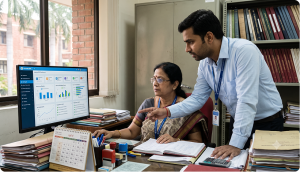
A mentor mentee program gives students a consistent point of contact for academic guidance, career planning, and support throughout college. As student numbers grow, maintaining mentoring records, tracking progress, and following up on concerns can become difficult when information is spread across registers, spreadsheets, and individual files.
A college ERP brings relevant student information and mentoring records into one platform, helping faculty review progress and provide more consistent guidance. This guide explores how a mentor mentee program works, its benefits for colleges, and how Edumate ERP supports mentorship-related activities.
What Is a Mentor-Mentee Program?
A mentor mentee program is a structured relationship in which a faculty member guides students through academic, personal-development, and career-related decisions. The mentor reviews the student’s progress, discusses challenges, offers guidance, and helps identify appropriate next steps.
The discussions may cover:
- Attendance patterns and internal examination marks
- Academic difficulties and areas requiring improvement
- Certification courses and skill development
- Career planning, internships, and placement preparation
- Concerns that require support from another department
The mentor is not expected to resolve every issue independently. Instead, the role involves identifying concerns, helping students make informed decisions, and coordinating with the HOD, placement cell, or other appropriate institutional teams when necessary.
A Mentor-Mentee Management System helps colleges organise student records, document mentoring interactions, and track follow-ups. Integrated with a college ERP, it gives faculty access to relevant academic and administrative information when reviewing a student’s progress.
This allows mentors to consider attendance, examination performance, certifications, and placement preparation together, making their guidance more relevant to each student’s needs.
How Does a Mentor Mentee Program Help Colleges?
A well-managed mentor mentee program supports faculty in their day-to-day interactions with students while giving institutions better visibility into mentoring activities. With organised records and consistent follow-ups, colleges can identify gaps in student support and review how effectively the programme operates.
For Mentors
- Early identification of struggling students: Attendance patterns and examination performance help mentors identify students who may need additional support. Edumate tracks attendance by subject and hour, helping faculty spot repeated absences and initiate discussions before academic difficulties escalate.
- Clear priorities for student outreach: Mentors handling multiple students need to know whom to contact first. RAG (Red, Amber, Green) indicators can help prioritise students based on their academic progress or other monitored criteria.
- Structured interactions: Recording mentoring discussions in a consistent format helps faculty review previous conversations, track agreed actions, and prepare for subsequent meetings. It also gives coordinators a more consistent basis for reviewing programme activity.
- Meeting requests and follow-ups: A structured meeting workflow gives students a way to seek guidance and helps mentors initiate discussions when concerns arise. Recording meeting requests, agreed actions, and due dates makes pending responsibilities easier to track. Where supported, status updates can also help mentors and students keep track of meeting progress.
- Continuity when assignments change: When a mentor takes leave, leaves the institution, or moves departments, access to the student’s previous mentoring records can help the next mentor understand earlier discussions and maintain continuity. A clear reassignment process also helps institutions establish responsibility for ongoing student support.
For Institutions
- Programme visibility: Coordinators and HODs need to know whether mentoring activities are taking place consistently. Consolidated reports can help them review student coverage, faculty participation, and pending follow-ups, making it easier to identify gaps before the end of the semester.
- Data-driven faculty guidance and academic monitoring: Reviewing student performance alongside mentoring activity can help HODs identify areas where additional academic support or faculty guidance may be needed. Comparisons should account for differences in student performance and the groups assigned to individual mentors.
- Streamlined documentation and audit readiness: Centralised records can reduce the effort required to collect information from individual faculty members during institutional reviews. Mentoring records and consolidated reports can help colleges organise evidence of student support activities. Institutions should map these records to the applicable NAAC, NBA, or NIRF requirements before using them in accreditation documentation.
- Student retention and placement support: Mentoring provides opportunities to address academic difficulties, identify skill gaps, and guide students towards certification and placement preparation. Edumate’s certification and placement records can help faculty review these areas. However, improvements in retention or placement should be established through institutional data, as these outcomes depend on several factors beyond mentoring alone.
Edumate Mentorship Program Module for Colleges
Edumate ERP supports mentorship-related activities through student profiles, attendance tracking, document management, certification records, placement information, and consolidated reporting. These capabilities help colleges organise information that faculty members may need when reviewing student progress.
The module covers six key areas:
| Module component | How it Supports Mentoring |
|---|---|
| Mentee Profile | Maintains personal details, academic history, and student progress information. |
| Attendance Tracking | Records attendance by subject and hour, helping faculty review patterns. |
| Document Management | Organises essential student documents for reference and review. |
| Student Certification | Maintains records of completed certification courses and learning achievements. |
| Placement Reports | Records placement activities, organisation names, and placement status. |
| Consolidated Reports | Brings relevant academic and student-development information together for review. |
These components provide a foundation for Mentor-Mentee Management for Colleges by making relevant student information easier to maintain and retrieve. Their practical value depends on how consistently faculty members update records and use them during mentoring activities.
Key Capabilities of Edumate Mentorship Module
Beyond maintaining student information, a mentorship module should support the wider mentoring process, from student allocation to follow-ups and institutional review. The following capabilities illustrate what colleges should look for when evaluating Mentor-Mentee Management for Colleges.
Bulk Allocation and Reassignment History
Assigning students individually can become time-consuming when a new batch joins or faculty responsibilities change. Bulk allocation can simplify the process by allowing coordinators to assign groups of students according to the institution’s allocation policy.
Reassignment is equally important. Colleges should establish whether the system maintains a history of previous assignments and preserves mentoring records when a student moves to another mentor. This helps maintain continuity and makes responsibility changes easier to review.
RAG-Banded Mentee Tracking
Red, Amber, and Green (RAG) indicators can help mentors distinguish students who need urgent attention from those who require monitoring or routine guidance.
- Red: Requires prompt review based on the indicators being monitored.
- Amber: Needs closer observation or a planned follow-up.
- Green: No immediate concern has been identified through the selected indicators.
The usefulness of this approach depends on the criteria behind each classification. Colleges should verify which indicators the system uses, whether they can be configured, and how faculty can review the circumstances behind a student’s status. A colour band should guide attention, not determine a student’s needs on its own.
360° Mentee Profile
Mentors need relevant context before discussing a student’s progress. A consolidated mentee profile can bring together academic information, attendance, certifications, placement activity, and previous mentoring records in one view.
This reduces the need to gather information from separate sources and helps faculty prepare more focused discussions. The exact information available in a consolidated profile depends on the modules and integrations supported by the ERP.
Two-Way Meeting Requests and Follow-Ups
Students should have a way to seek guidance when they need it, while mentors should be able to initiate discussions when they identify a concern.
A structured meeting workflow may include:
- Meeting requests initiated by students or mentors
- Preferred dates and meeting status
- Records of discussions and outcomes
- Follow-up actions with due dates and completion status
When these functions are available, structured requests and follow-up tracking reduce reliance on informal messages and help both parties keep track of agreed actions.
Document and Report Management
Mentoring involves information that may need to be reviewed throughout a student’s academic journey. Document management helps organise relevant records, while consolidated reports give coordinators a broader view of programme activity.
These records can help institutions review faculty participation, student coverage, and mentoring activity. The reports used for internal reviews should reflect the institution’s reporting requirements.
HOD Activity View and Role-Based Dashboards
HODs and programme coordinators need an overview of mentoring activities across their departments. Department-level reporting can help them review faculty participation, identify students who may need attention, and follow up on outstanding responsibilities.
Role-based dashboards organise information according to institutional responsibilities, helping each role focus on the activities relevant to its work. Access to student records should also reflect the institution’s policies and the responsibilities assigned to each user.
Improve Campus Mentor-Mentee Program with Edumate ERP
A successful mentor mentee program requires more than faculty allocation. Colleges need consistent documentation, relevant student information, and a clear process for reviewing progress and following up on concerns.
Edumate ERP supports mentorship-related activities through mentee profiles, attendance tracking, document management, certification records, placement reports, and consolidated reporting. These capabilities help institutions organise information for academic guidance and career development.
To evaluate the fit for your institution, ask the iTech team to demonstrate how student records are maintained, what reports are available, and how the module supports your existing mentoring process.
Explore Edumate ERP for Higher Educational Institutions to learn more about its academic and administrative management capabilities.