
Introduction — Why Anticipating Obsolescence Matters
“How to predict manufacturing component obsolescence?” This question, searched by thousands of engineers and supply chain professionals each month, and it points to a multi-billion-dollar challenge.
Product obsolescence is the end-of-life for a component, driven by technological shifts, falling demand, or physical wear. It has always posed risks, but unexpected obsolescence now threatens operations, inventory, and customer satisfaction. Spare parts shortages, supply chain disruptions, and wasted inventory can quickly escalate costs and harm a company’s reputation.
Traditionally, obsolescence management has been reactive, with teams responding only after issues arise. Today, Artificial Intelligence (AI) is transforming this approach by enabling proactive forecasting. By analyzing sales patterns, maintenance data, supplier roadmaps, and market trends, AI provides predictive insights. This isn’t just about predicting the end; it’s about gaining the insight needed for smarter lifecycle management, optimized inventory, and resilient supply chains. In short, AI helps manufacturers cut costs, prevent disruptions, and protect customer trust.
Challenges: The Pitfalls of Current Obsolescence Management
Despite best efforts, many manufacturers remain exposed to financial and operational risks. Common challenges include:
1. Over-reliance on Historical Data
Current obsolescence management often depends only on historical data, such as past usage or records. This approach can be limited, providing delayed or incomplete insights and making it difficult to anticipate future changes effectively.
2. Missing the Early Warning Signs
Key indicators like rapid tech shifts, fluctuating component availability, and limited supplier roadmap visibility are often missed. Without these signals, production delays and inventory shortages become a matter of ‘when,’ not ‘if.’
3. Poor Visibility Across the Product Lifecycle
Fragmented systems and siloed data prevent a full understanding of a product’s lifespan, from usage and peak demand to support and decline phases. This lack of visibility makes proactive planning nearly impossible.
4. Costs and Risks of Being Reactive
The consequences are severe and direct:
- Forced last minute redesigns
- Scrapped inventory
- Legal or warranty obligations
- Customer dissatisfaction
Reactive measures increase operational costs and damage brand reputation, reducing long-term competitiveness.
These challenges highlight the need for AI-driven, proactive obsolescence management, empowering manufacturers to forecast risks, optimize inventory, and maintain seamless supply chain operations.
5. The Execution Bottleneck
Even after an EOL risk is identified, manual research, part matching, and cross-system handoffs can delay the response. Teams may spend time finding suitable alternatives, checking availability, and coordinating procurement and engineering updates, allowing an identified risk to become an operational disruption.

Solutions: How AI Enables Obsolescence Prediction
Data Sources & Key Indicators
Effective prediction starts with the right data. AI models analyze multiple streams, from internal usage statistics and sales trends to external factors like part availability, technology lifecycles, competitor innovations, and regulatory changes. By connecting these dots, manufacturers gain early warnings about potential end-of-life events. With timely insights, they can make proactive decisions and avoid costly disruptions.
Forecasting Techniques
Machine learning models assess the risk of components becoming obsolete and estimate when parts might become unsupported. At the same time, autonomous monitoring agents continuously track distributor APIs, vendor portals, and regulatory filings to catch EOL announcements in real time without human intervention. These insights help companies plan inventory, schedule replacements, and maintain production continuity.
Handling Low-Data Scenarios
Limited data doesn’t mean limited foresight. Techniques like data augmentation, clustering similar components, transfer learning, and semi-supervised learning help AI models remain accurate. When data is sparse, alternative discovery agents can also parse technical datasheets across parametric databases to identify pin-compatible, Form-Fit-Function (FFF) replacement parts. This helps manufacturers evaluate alternatives even for rarely used components.
Scenario Analysis & What-If Planning
Finally, AI supports obsolescence scenario analysis. Manufacturers can simulate the impact of supplier discontinuations, regulatory changes, or technology replacements. These “what-if” simulations turn uncertainty into strategy, enabling smarter life-cycle management, optimized inventory, and stronger supply chain resilience.
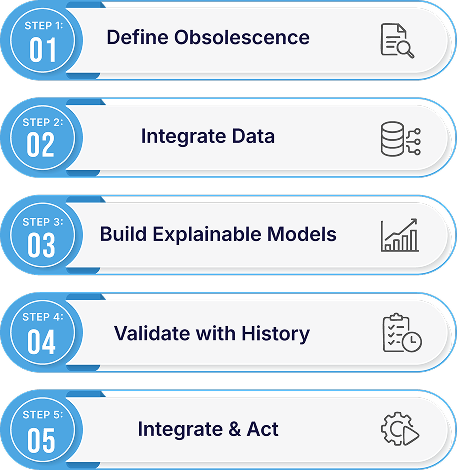
A 5-Step Framework for Implementing AI Obsolescence Prediction
Successfully predicting product or component obsolescence requires a structured approach that combines data, AI, and actionable workflows.
Step 1: Define Your Obsolescence Trigger
Start by clearly identifying what “obsolescence” means for your products.
- Supplier-Driven: A supplier announces End-of-Life (EOL) and stops accepting orders.
- Technology-Driven: A new technology makes the current component inefficient or unsupported.
- Demand-Driven: Sales fall below a sustainable threshold, making production unviable.
Actionable Insight: Align your definition with actual business impact. Is the trigger a financial, operational, or compliance risk?
Step 2: Collect and Integrate Relevant Data
For prediction accuracy, collect and integrate relevant data from both internal and external sources to create a comprehensive dataset.
| Data Source | Examples | Predictive Value |
|---|---|---|
| Internal Data | Sales volumes, maintenance logs, R&D project roadmaps, customer feedback. | Reveals internal usage patterns and future replacement plans. |
| External Data | Supplier EOL notices, market analyst reports, patent filings, technology lifecycle curves. | Provides early warning signals from the broader market and supply chain. |
Step 3: Build Explainable Models
The AI models you use should not only be accurate but also transparent. Explainable AI helps to build models that clearly show why a component is flagged as high-risk. This transparency builds trust and helps stakeholders make informed, confident decisions.
Step 4: Validate with History
Test your models against your own historical obsolescence events. How early would the system have warned you? This validation proves value and helps refine the model’s accuracy.
Step 5: Integrate Predictions into Workflows
Embed AI predictions directly into product-lifecycle workflows so agents can execute actions such as:
- Procurement Execution: A procurement agent can calculate buffer stock based on demand, verify ERP inventory levels, and draft a Last-Time Buy (LTB) purchase order for single-click approval.
- Engineering Workflow: An engineering agent can extract parametric specifications for alternative components and auto-generate an Engineering Change Order (ECO) draft directly inside the PLM system.
- Engineering Workflow: An engineering agent can extract parametric specifications for alternative components and auto-generate an Engineering Change Order (ECO) draft directly inside the PLM system.
Outcome: Following these steps enables proactive obsolescence management, reduces operational risks, and ensures smooth, uninterrupted supply chain operations.

Business Benefits of Obsolescence Prediction
By shifting from reactive firefighting to proactive planning through predicting obsolescence, businesses unlock measurable value across operations.
Reduced Risk of Shortages
AI-driven prediction helps organizations avoid sudden part shortages. Instead of hastily sourcing alternatives, companies can plan secure supply chains well in advance.
Lower Inventory Costs
Traditional stockpiling often leads to overstocking or scrapping aged inventory. Obsolescence prediction enables smarter procurement, ensuring businesses buy only what’s needed, saving dollars in inventory waste.
Smarter Planning Decisions
From R&D design choices to supply chain strategy, predictive insights guide decision-making. Teams can proactively schedule redesigns and optimize procurement with confidence.
Competitive Advantage
Looking ahead sets businesses apart. Companies that anticipate technology shifts can assure customers of product continuity, avoid costly delays, and position themselves as more reliable than competitors.
Efficient Resource Allocation
Obsolescence prediction reveals where investment makes the most impact, whether in redesign, extended support, or migration plans. This ensures time, money, and talent are directed to the right priorities.
In essence, predictive obsolescence management builds resilience, drives efficiency, and earns customer trust, transforming risk into opportunity.
Why Custom Software is a Better Fit
When it comes to obsolescence prediction, one size rarely fits all. Off-the-shelf tools may seem convenient, but they often fall short of addressing the complex realities of modern manufacturing. They typically provide passive metric dashboards rather than executing actions, leaving critical gaps between identifying an obsolescence risk and responding to it.
Custom software, by contrast, is engineered to work seamlessly with your ecosystem. It integrates directly with your ERP and PLM systems and connects to maintenance or warranty databases. This ensures every prediction is grounded in accurate, real-time data, rather than fragmented information silos.
Another advantage is flexibility. With custom solutions, businesses define their own obsolescence rules, thresholds, and sign-off requirements. Multi-agent orchestration can then coordinate actions across ERP and PLM workflows based on these company-specific rules, whether it involves supplier roadmaps, component aging, or regulatory changes. This turns obsolescence intelligence into controlled, actionable workflows.
Scalability is equally vital. As your product portfolio grows, markets shift, or new data streams emerge, custom-built solutions adapt without disruption. This future-proof design ensures predictive accuracy remains strong, even as your business evolves.
| Feature | Off-the-Shelf Software | Custom-Built Solution |
|---|---|---|
| Data Integration | Limited, pre-defined connectors | Seamless integration with your exact systems (ERP, PLM) and workflow data |
| Business Rules | Generic, industry-average thresholds | Fully customizable rules, thresholds and sign-off requirements |
| User Experience | Passive dashboards focused on metrics and alerts | Multi-agent workflows tailored to user roles and approval requirements |
| Future Adaptability | Stays mostly static | Grows and adapts with new processes, goals, and technologies. |
In essence, custom software for obsolescence management delivers more than prediction. By enabling multi-agent orchestration across company-specific ERP and PLM rules, workflows, and sign-off thresholds, it turns identified risks into controlled actions that off-the-shelf platforms simply can’t match.
Conclusion – From Prediction to Preparedness: Building an Operational Strategy
Obsolescence prediction is more than a safeguard; it’s a strategy for resilience and growth. By shifting from reactive fixes to predictive foresight, manufacturers reduce risks, avoid costly disruptions, and ensure long-term operational stability. Reliable forecasting strengthens planning, optimizes resources, and keeps supply chains steady in fast-changing markets.
The real value lies in moving from insight to action. With custom obsolescence management solutions, tailored dashboards, and seamless system integration, decision-makers gain the clarity to act early and strategically. The result is not just prediction, but preparedness, future-proofing operations for lasting success.
Ready to future-proof your supply chain? Discover how AI-driven obsolescence prediction can help your business reduce risks, optimize inventory, and maintain operational continuity.