Introduction
Artificial Intelligence is evolving rapidly, and with that evolution comes a fundamental shift in how we define and deploy intelligent systems. Two terms now central to this conversation are Generative AI and Agentic AI.
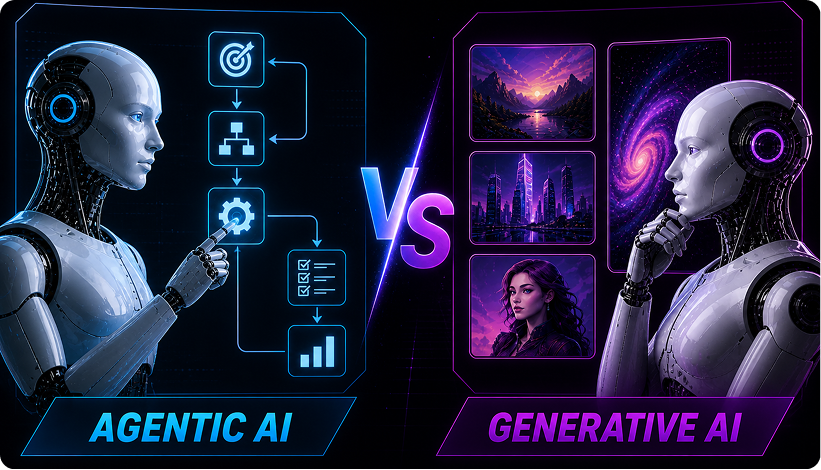
While both belong to the same broader ecosystem and share underlying technologies like Large Language Models (LLMs), their purpose, behavior, and business impact are distinct. The core difference is simple: Generative AI creates; Agentic AI acts.
This distinction is critical. Modern businesses are moving beyond using AI solely as a tool for content generation and toward deploying it as a system that can make decisions and execute tasks independently. For any organization planning, understanding the boundary between these two is the essential starting point for a scalable AI strategy.
What is Generative AI?
Generative AI (GenAI) is a specialized branch of artificial intelligence designed to create. While traditional AI focuses on classifying data or surfacing predictions, generative systems produce entirely new content ranging from text and code to images and video by recognizing patterns across massive datasets.
At its core, GenAI works through probability. When a user submits a prompt, the model identifies the underlying structures of its training data and predicts the most relevant sequence of information to “build” a response in real time. This allows tools like ChatGPT, GitHub Copilot, and Midjourney to generate human-quality writing or complex visuals in seconds.
Core Characteristics
Generative AI is defined by several key traits that distinguish it from other technologies:
- Prompt-Driven: It is fundamentally reactive, waiting for specific user input before producing a response.
- Content-Focused: Its primary purpose is the synthesis of new material rather than mere analysis.
- No Independent Agency: It lacks the ability to set its own goals or act beyond its output.
By design, Generative AI acts as a powerful force multiplier for human productivity. It does not “think” independently, but it mimics the creative process with incredible speed, transforming prompts into tangible, high-quality content.
Common Use Cases of Generative AI
Generative AI has quickly integrated into nearly every corner of business and creative work, acting as a powerful force multiplier. By handling the heavy lifting of initial production, it allows professionals to move from concept to completion at an unprecedented pace.
Here is how GenAI is making a tangible difference across various functions:
Creative Production & Media
- Image and Video Content Creation: Designers and marketing teams use AI to generate visuals, animations, and video effects. This allows for rapid prototyping of entire campaigns in hours rather than weeks, significantly reducing production cycles.
- Music and Audio Creation: AI-generated music, voiceovers, and sound effects are now common in advertising and podcasting. Artists and producers use these models to explore new creative directions or fill production gaps efficiently.
Development & Digital Presence
- Software Development: Developers use tools to autocomplete functions, suggest complex logic, and identify potential bugs in real time. This minimizes the time spent on repetitive coding tasks and documentation searches.
- Website Development: From drafting initial copy to generating layout ideas and basic code, AI helps teams build web experiences faster. This eliminates traditional bottlenecks during the early, most labor-intensive stages of development.
Business Communication & Operations
- Marketing Email and Text Content Creation: Sales and marketing teams rely on AI to draft email sequences, ad copy, and social content. This ensures a consistent brand voice and allows for high-volume content production without sacrificing quality.
- AI Chat Responses: Customer support chatbots powered by generative models handle common queries and maintain a natural, conversational tone across thousands of simultaneous interactions.
Intelligence & Insights
- Research and Learning: Professionals use AI as a smart research partner to explain complex topics, generate learning materials, and synthesize dense information faster than traditional study methods allow.
- Ecommerce Personalized Recommendations: By analyzing customer behavior, AI crafts tailored product suggestions that feel individual rather than generic, directly impacting conversion and retention.
- Data Summarization: Long reports, meeting transcripts, and research papers are condensed into clear, actionable summaries. This saves hours of manual review and ensures teams stay aligned on the most critical information.
What is Agentic AI?
Agentic AI represents a fundamental shift from reactive tools to autonomous systems. While Generative AI waits for a specific brief, Agentic AI is designed to pursue high-level goals independently. It doesn’t just respond to a prompt; it gets things done by planning, making decisions, and executing multi-step tasks with minimal human intervention.
Think of the difference in professional terms: if Generative AI is a skilled specialist who produces work based on a brief, Agentic AI is a project manager. It takes a broad objective, breaks it down into actionable steps, and navigates through them until the goal is reached. These systems can browse the web, call APIs, manage files, and coordinate across platforms to complete a project end-to-end.
Key Characteristics
The defining quality of Agentic AI is autonomy combined with purpose. Its core strengths include:
- Goal-Oriented Behavior: It acts proactively to achieve a result rather than just generating a static response.
- Autonomous Decision-Making: It evaluates options and chooses the best path forward based on the context.
- Tool Integration: It interacts with external environments, runs code, and uses software tools just like a human would.
- Continuous Adaptation: It observes the results of its actions and adjusts its strategy in real time based on feedback and memory.
By combining reasoning, memory, and execution, Agentic AI moves beyond simple content generation. It is a dynamic partner capable of navigating complex workflows, making it an essential evolution for true digital automation.
Common Use Cases of Agentic AI
Industries that manage high data volumes, complex decision-making, and time-sensitive outcomes are seeing the most immediate benefits from agentic systems. By moving from simple analysis to autonomous action, these organizations are streamlining operations that previously required heavy manual oversight.
Financial Services & Compliance
- Fraud Prevention: Agentic AI continuously monitors transaction streams in real time. When it identifies suspicious patterns, it doesn’t just flag them; it takes immediate protective action, such as freezing the activity, while simultaneously notifying human reviewers.
- Loan and Credit Automation: These systems evaluate income data, credit histories, and supporting documentation simultaneously. By processing these variables in parallel, they reach informed lending decisions in minutes rather than days.
- Regulatory Reporting: In the high-stakes world of banking, Agentic AI handles KYC (Know Your Customer) verification, audit trail creation, and regulatory reporting automatically, significantly reducing human error and compliance overhead.
Healthcare & Clinical Operations
- Patient Monitoring: In clinical settings, agentic systems watch patient vitals 24/7. If readings cross a safety threshold, the system alerts the care team immediately, removing the delay inherent in scheduled manual checks.
- Medical Data Analysis: By synthesizing imaging data, lab results, and patient records, these agents surface critical insights that allow clinicians to make faster, data-backed diagnostic decisions.
- Clinical Workflow Automation: Tasks like appointment coordination, prescription verification, and resource scheduling are handled behind the scenes, allowing medical staff to dedicate more time to direct patient care.
Ecommerce & Logistics
- Dynamic Store Experiences: Agentic AI goes beyond static recommendations. It monitors browsing patterns and contextual signals like local weather or events to dynamically adjust the digital storefront in real time for every individual user.
- Inventory Management: The system tracks shifting variables like stock levels and supplier lead times, autonomously triggering reorders before a product runs out to ensure operations remain seamless.
- Delivery and Support: When a logistics issue occurs, the AI can identify the delay, proactively notify the customer, and reschedule the delivery, all without waiting for a support ticket to be filed.
Agentic AI vs Generative AI: Key Differences
The question of generative AI vs agentic AI often comes down to one distinction: response versus action.
| Dimension | Generative AI | Agentic AI |
|---|---|---|
| Core Purpose | Content Creation: Focused on producing high-quality text, imagery, or code. | Goal Attainment: Focused on achieving specific business outcomes and completing tasks. |
| Initiative | Reactive: Acts only when triggered by an explicit user prompt. | Proactive: Initiates actions independently based on high-level goals or environmental triggers. |
| Workflow | Single-Turn: Operates in a linear request-response cycle. | Multi-Step: Decomposes complex objectives into a logical sequence of actions. |
| Autonomy | Human-Dependent: Requires constant human input and guidance to progress. | Autonomous: Operates with minimal intervention once the initial parameters are set. |
| Tool Usage | Internal: Primarily functions within its own pre-trained model boundaries. | Integrated: Connects with external APIs, databases, and software to execute work. |
| Decision Making | Probabilistic: Predicts the next logical data point based on learned patterns. | Reasoning-Based: Evaluates multiple options and selects the optimal path toward a goal. |
| Adaptability | Static: Follows the original prompt strictly without adjusting its strategy. | Dynamic: Observes results and pivots its approach to overcome obstacles. |
| Memory | Short-Term: Generally limited to the context of the current conversation. | Stateful: Retains long-term context across tasks to refine performance over time. |
| Success Metric | Output Quality: Judged by the accuracy, tone, and creativity of the generated content. | Outcome Success: Judged by whether the end-to-end task was completed successfully. |
| Risk Profile | Information Risk: Primary concerns are factual errors or hallucinations. | Operational Risk: Primary concerns involve autonomous actions impacting real-world systems. |

A Real-World Comparison: Customer Service
To visualize how these differences function in practice, consider a scenario where a customer requests a refund for a delayed shipment:
With Generative AI:
- The Prompt: You ask the AI: “Draft an empathetic email to a customer whose package is three days late.”
- The Output: The AI generates a high-quality, professional draft
- The Manual Gap: A human employee must then copy the text, look up the customer’s order in a separate system, verify the delay, and manually hit send.
With Agentic AI:
- The Goal: You set a high-level objective: “Handle all inquiries regarding shipping delays for orders under $50.”
- The Action: The AI detects the incoming email, identifies the order number, and calls the shipping API to verify the status autonomously.
- The Resolution: It decides to issue a $10 credit based on company policy, updates the internal database, drafts the response, and sends the email without human intervention.
- The Guardrail: The system only alerts a human operator if the refund amount exceeds its authorized limit or if the case is unusually complex.
Key Takeaway: If Generative AI provides the “brain” and the “voice,” Agentic AI provides the “hands” and the “judgment” required to execute a full workflow from start to finish.
Deploying Agentic and Generative AI
Understanding the distinction between Generative and Agentic AI is the first step; knowing how to deploy them effectively is where businesses gain a real competitive edge. Most organizations find that the most powerful strategy is not choosing one over the other, but rather building a layered approach where both technologies work in tandem.
When to Deploy Each
Generative AI is typically the ideal starting point. It is easier to implement, carries a manageable risk profile, and allows for rapid iteration. It excels when your primary goals involve content creation, knowledge assistance or basic communication automation such as internal knowledge retrieval or drafting scripts for customer support.
Agentic AI requires a more sophisticated architecture due to its autonomy. It is the right choice for end-to-end process automation, decision-making systems, and complex workflow orchestration. Because these systems act independently, deployment requires careful attention to guardrails, escalation paths, and “human-in-the-loop” checkpoints to ensure proper oversight.
The Combined Approach: A Powerful Synergy
The most effective modern AI systems use a layered strategy: Generative AI creates the insights, while Agentic AI decides what to do with them.
- Step 1 (Generative): The system drafts a complex technical response for a customer inquiry.
- Step 2 (Agentic): The agentic layer analyzes the sentiment, verifies the customer’s account status, and decides whether to send the reply, escalate it to a human manager, or modify the response based on real-time data.
By moving from simple tools to autonomous systems, businesses can automate entire workflows that previously required a full team. This evolution allows human employees to shift away from manual execution toward high-level oversight, maximizing both creative output and operational efficiency.
How iTech Can Help
Bridging the gap between understanding AI and putting it to work is where iTech adds the most value. With over two decades of experience across healthcare, logistics, finance, and ecommerce, we design AI strategies grounded in practical industry realities, not generic frameworks.
Generative AI Expertise
We bring deep expertise in large language model customization, document intelligence, and AI-powered data extraction. From automated invoice processing and CAD document analysis to resume parsing and summarization, we build production-ready tools tailored to the specific data challenges your business faces daily.
Agentic AI Specialization
iTech specializes in designing and deploying multi-agent architectures that automate complex, multi-step workflows. Our systems include robust orchestration, state management, and fault tolerance. Whether your goal is autonomous lead qualification, real-time compliance reporting, or clinical workflow automation, we build systems that operate reliably under real-world business conditions.
Every solution we build is centered on your specific workflows, your data, and your existing technology stack. That specificity ensures results that hold up in day-to-day operations.
The shift from AI that creates to AI that acts is already underway. iTech has the experience to help your business lead that transition.
Ready to build AI that works? Contact the iTech team today.