AI-Assisted Wiring Harness Revision Comparison for Automotive Engineering

Accelerating Engineering Review of Wiring Harness Revisions with Automated Change Detection 

Automatically identifying likely change areas between automotive wiring harness drawing revisions while providing engineers
with a measurable, ranked review aid.

Challenges

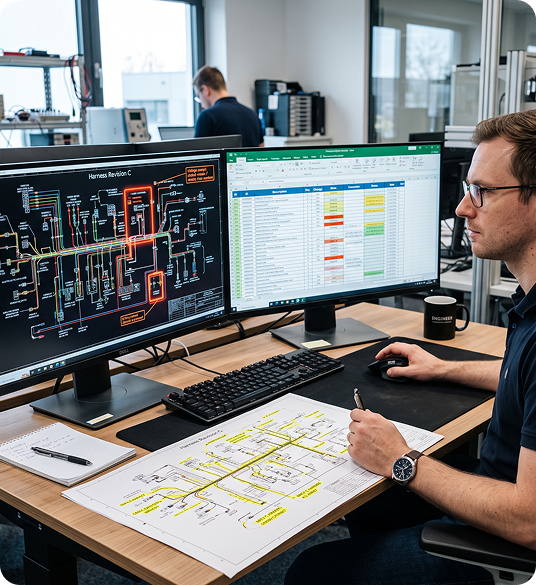
  • Manual Change Verification: Engineers manually compare old and new harness drawing revisions, highlight every change, and prepare change summaries. This makes the review process time-consuming and increases the risk of missed changes or documentation errors. 
  • Redrawn Revision Geometry: Direct drawing comparisons become unreliable when revisions are redrawn rather than edited in place. In the evaluated sample, drawing content shifted by approximately 50 pixels across the sheet, while an entire general-notes block had moved, creating significant comparison noise.
  • Low-Resolution CAD Plots: The source drawings were supplied as 200 dpi bilevel raster plots. Disconnected vector paths, raster artifacts, compressed CAD fonts, and limited image quality reduced the accuracy of both image-based comparison and text recognition.
  • High False-Alarm Rates: Conventional image comparison flagged 137 of 232 drawing zones as changed despite only 28 representing genuine revision updates, creating excessive review noise and making it difficult for engineers to focus on the areas most likely to contain real changes. 
  • Inconsistent Text Recognition: OCR extracted 23 part numbers from one revision and 19 from the other, but only 9 matched identically across both drawings. This limited the reliability of text-based methods for identifying and validating revision changes.

The Solution

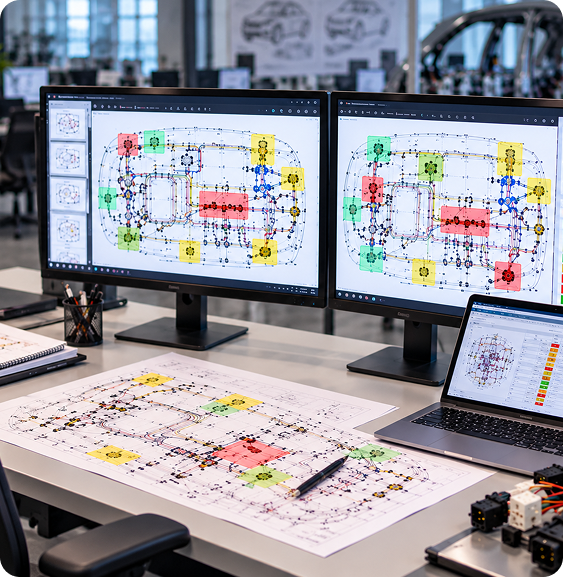
iTech evaluated multiple approaches against the customer’s own manually marked drawing rather than relying on subjective assessment. The marked-up sheet contained 39 highlighter marks across 31 change zones, creating a customer-defined benchmark for measuring automated review accuracy. The proof of concept was designed as an engineering review aid that prioritizes likely revision locations; it does not automatically determine or validate the exact engineering changes.

Business Outcomes & Impact

iTech India
Privacy Overview

iTech uses cookies so that we can provide you with the best user experience possible. Cookie information is stored in your browser and performs functions such as recognizing you when you return to our website and helping our team to understand which sections of the website you find most interesting and useful.